Beyond Intelligent Robots (Part 4): Scaling Physical AI — The Strategic Role of Engineering Partnerships
An industry thought leadership series by Infocusp Innovations
Beyond Intelligent Robots is a four-part thought leadership series exploring the technologies, platforms, ecosystems and engineering shaping the next era of intelligent manufacturing. Drawing on emerging industry trends and real-world developments, the series examines how Physical AI is redefining industrial innovation, and what it will take for technology companies to lead in this new era.
Synopsis
As Physical AI moves from innovation to industrial deployment, engineering capability becomes a strategic business consideration. This concluding article explores how engineering partnerships can help organisations strengthen capability, accelerate growth and support long-term product evolution, while examining the characteristics that distinguish effective engineering partnerships.
Every technology cycle produces a small number of companies that demonstrate what is possible.
Far fewer succeed in turning that capability into a repeatable commercial offering that can be deployed reliably across customers, industries and geographies.
That distinction matters. The gap between invention and industrial scale has defined every major technology transition, and Physical AI is no exception.
Developing an intelligent robot or an AI-enabled industrial system is a significant technical achievement. Building the organisation, processes and engineering capability required to deliver, integrate, support and continuously improve that solution across multiple customer environments is a different challenge altogether.
As adoption accelerates, it is becoming clear that scaling a Physical AI business requires more than a strong product. It requires an operating model capable of supporting deployment at industrial scale.
The next phase of Physical AI will therefore be shaped not only by technological progress, but by how effectively that progress is engineered, implemented and sustained.
From Technical Breakthrough to Commercial Deployment
The first wave of Physical AI companies has been built on deep technical expertise.
Some have focused on robotics. Others have specialised in perception systems, AI models, simulation, industrial software or autonomous platforms. These organisations have delivered important innovations, and the pace of development remains strong.
Commercial success, however, introduces a different set of requirements.
Customers are no longer assessing a prototype or a demonstration. They are evaluating whether a solution can integrate into existing production environments, operate reliably, meet safety and compliance expectations, adapt over time and deliver measurable business value.
At that point, the central question changes from “Can it work?” to “Can it work here, at scale, and with consistency?”
That shift creates engineering demands that extend well beyond the original product concept.
Why Scale Changes the Engineering Equation
As engineering requirements expand, organisations begin making decisions about how capability should be developed.
Some capabilities remain closely aligned with proprietary technology and internal product development. Others benefit from specialised expertise that may not need to exist entirely within one organisation.
These decisions are rarely driven by technology alone. They reflect product strategy, customer expectations, speed of execution, access to specialist skills and long-term business priorities.
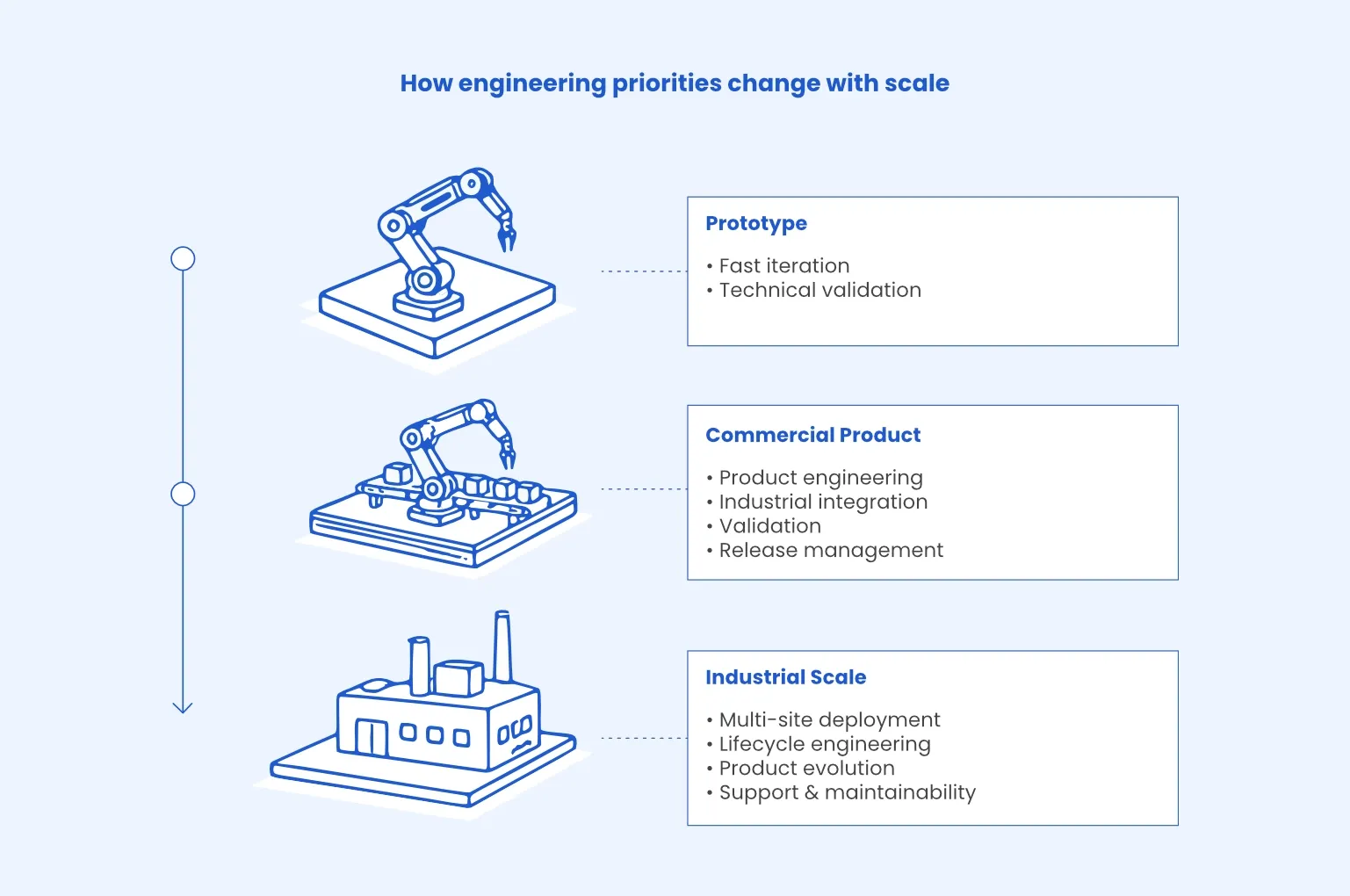
The reason is that engineering itself changes as products move from initial deployment to broader commercial adoption.
Engineering teams must think about standardisation, modularity and interoperability from the outset. They need release processes that support frequent iteration without compromising stability. They need testing frameworks that can validate performance across different environments, not just in the laboratory. They need visibility into how systems behave in the field so that issues can be identified early and improvements can be incorporated into future product releases.
At scale, even small design decisions begin to have commercial consequences.
- A component that is difficult to service increases downtime.
- A software architecture that is hard to update slows deployment.
- A hardware configuration that is too bespoke increases cost and complexity.
- Limited observability makes support reactive rather than proactive.
In other words, scaling does not simply increase the volume of engineering work. It changes the nature of the engineering problem itself.
For many organisations, the objective is therefore not simply to increase engineering capacity. It is to strengthen engineering capability while allowing internal teams to remain focused on the areas that create long-term differentiation.
Engineering Partnerships as a Growth Strategy
This is where engineering partnerships become strategically important.
Not as a substitute for internal capability. Not simply as additional delivery capacity. But as an extension of the organisation’s engineering function.
The most effective partnerships bring specialised expertise that complements internal teams while allowing product companies to remain focused on their core technologies, product strategy and long-term roadmap.
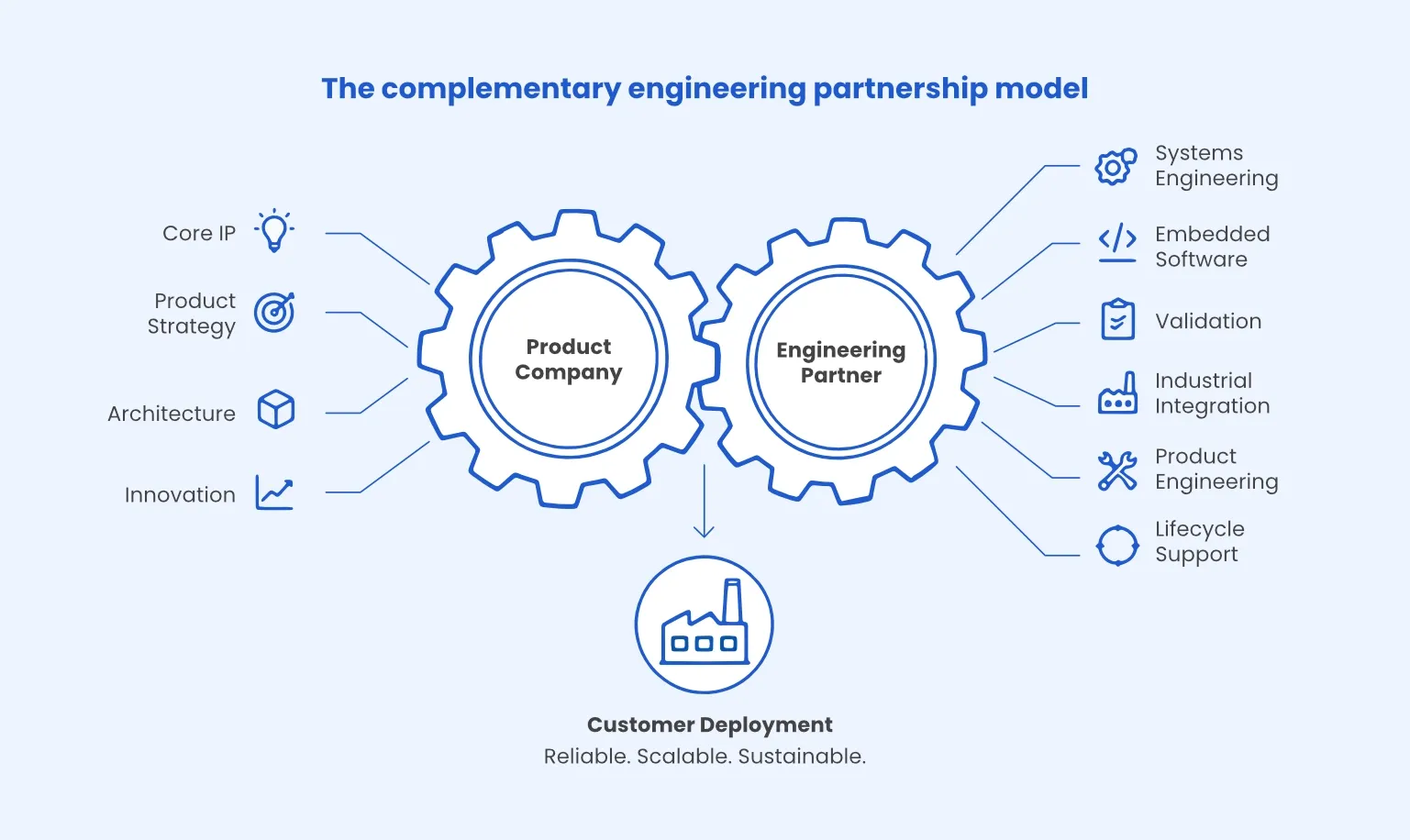
In this model, engineering becomes a shared capability rather than a siloed function.
Internal teams continue to lead product vision, architecture and innovation. Engineering partners contribute specialist capability across product engineering, software, embedded systems, industrial integration, validation and lifecycle support.
Together, they create the capacity to move faster without compromising quality, reliability or maintainability.
What Distinguishes Effective Partnerships
Effective partnerships are built on alignment, technical depth and a shared understanding of what success looks like in industrial environments. As Physical AI solutions become more sophisticated, several characteristics consistently support long-term collaboration.
- A deep understanding of industrial engineering and manufacturing environments. Effective partners understand how production constraints, safety requirements, uptime expectations and integration dependencies influence engineering decisions. This enables solutions that are practical to deploy, support and scale.
- The ability to integrate multiple engineering disciplines. Physical AI combines robotics, embedded systems, software, AI, controls, testing and industrial integration. Strong partners bring these disciplines together within a coherent engineering approach, reducing complexity and improving coordination across development teams.
- Flexibility to respond to evolving product and customer requirements. As products mature, engineering priorities inevitably change. Customer feedback, deployment experience and commercial requirements all influence the product roadmap. Effective partners adapt to these changes while maintaining engineering continuity and architectural integrity.
- Close collaboration with internal engineering and product teams. Successful partnerships operate as an extension of the organisation rather than as an external delivery function. Shared technical standards, transparent communication and common objectives improve decision-making and strengthen product quality.
- A long-term approach to product evolution. Physical AI products continue to evolve long after their initial deployment. Partners that understand lifecycle engineering are better positioned to support continuous improvement, future product generations and long-term customer success.
- A disciplined approach to quality, reliability and maintainability. Rapid development remains important, but robust engineering becomes equally critical as products scale. Effective partners help ensure systems remain testable, supportable and resilient throughout their operational life.
- An understanding of the commercial impact of engineering decisions. Engineering choices influence far more than technical performance. They affect deployment speed, serviceability, cost, customer experience and long-term product competitiveness. The most effective partners understand that engineering and commercial outcomes are closely connected.
Together, these characteristics help organisations strengthen engineering capability while continuing to invest in product innovation and long-term growth.
The Outlook for Physical AI
The organisations that succeed in Physical AI will continue to invest in innovation. Equally important will be their ability to develop the engineering capability required to deploy, support and evolve products as customer expectations grow.
How that capability is built will differ from one organisation to another. Some will continue expanding internal engineering teams, while others will complement those capabilities through long-term engineering partnerships that provide access to specialised expertise.
There is no single approach that applies to every organisation. The right model will depend on product strategy, market priorities and the capabilities each business chooses to develop internally.
What is becoming increasingly evident, however, is that engineering capability is now closely connected to how organisations introduce new products, support industrial deployment and respond to customer requirements over time.
About the Beyond Intelligent Robots Series
This article concludes Beyond Intelligent Robots, a four-part thought leadership series exploring the technologies, engineering approaches and business considerations shaping the future of Physical AI.
Across the series, we explored the evolution of Physical AI — from intelligent machines and open robotics ecosystems to the engineering disciplines and organisational capabilities that support industrial-scale adoption.