
Blockchain's Journey from Utopian Hype to Pragmatic Infrastructure
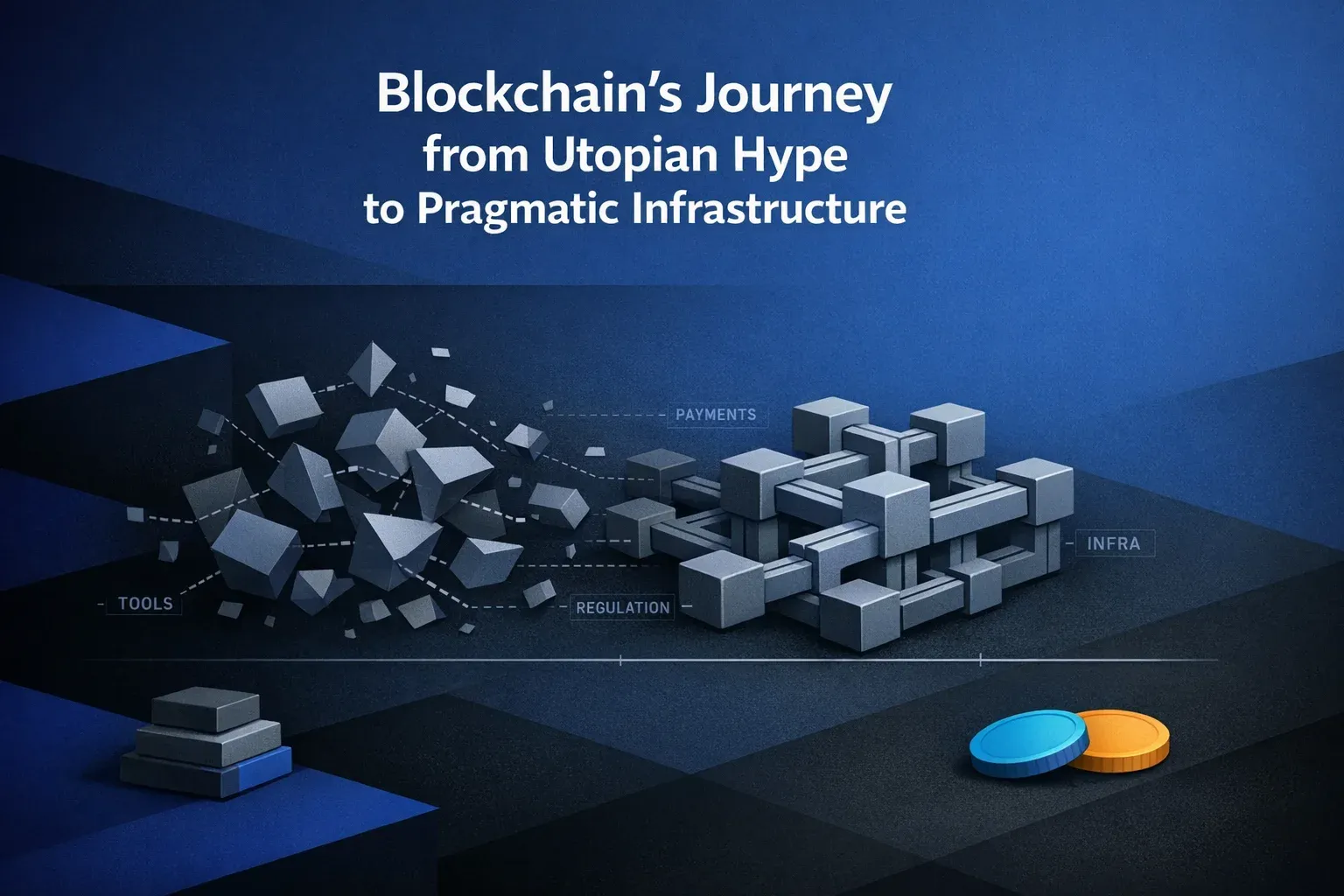
Blockchain Grows Up: From Speculative Hype to Invisible Infrastructure
For nearly a decade, blockchain was a technology defined by hype. It was a chaotic mix of soaring token prices, digital collectibles sold for millions, and a pervasive belief that code would immediately replace every institution we knew. But if you look around today, the noise has faded. The headlines about “the next Bitcoin” are fewer, and the frantic rush to decentralize everything, from your toaster to your social media profile, has slowed.
To the casual observer, this silence might look like failure. But to those paying attention, it is something far more important: Maturity.
The ecosystem hasn’t collapsed; it has corrected. We are witnessing a transition from a speculative “Wild West” to a high-utility industrial era. This is the story of how blockchain finally grew up.
The Developer Renaissance: Outgrowing the Training Wheels
The first sign of this maturation wasn’t a price rally, it was a quiet cleaning of the house. In late 2023, Consensys announced the sunsetting of Truffle and Ganache, two tools that had practically defined Ethereum development for years [1].
At the time, skeptics pointed to this as a sign of a shrinking ecosystem. They were wrong. As the Consensys announcement noted, the decision was driven by a need to prioritize modern infrastructure like MetaMask and Infura. But the deeper truth was “Ecosystem Darwinism.”
Developers hadn’t stopped building; they had simply demanded better tools. The industry graduated to Hardhat and Foundry, environments built with Rust and TypeScript that offer faster compilation and professional-grade debugging. This shift mirrors the evolution of the web itself, where early, clunky tools eventually gave way to streamlined powerhouses like React and Kubernetes. The sunsetting of Truffle wasn’t an abandonment; it was an upgrade to professional engineering standards.
The Pragmatic Turn: When Ideology Met Reality
As developer tools sharpened, the industry also had to face a hard truth about user experience (UX): Ideology is not a product strategy.
For years, projects tried to force decentralization into places where it added friction rather than value. A prime example was Brave Browser’s decision to step back from native IPFS support. While the integration was ideologically aligned with a decentralized web, Brave found that the practical reality, high maintenance costs and inconsistent performance, didn’t justify the feature for the average user [2].
This same correction played out in gaming. The “Play-to-Earn” model, typified by Axie Infinity, collapsed under the weight of its own economic unsustainability. When the financial incentives dried up, the players left, proving that games must be fun first and financialized second. The data was brutal: blockchain gaming investment plummeted 72% in 2023 [3], and hundreds of games were discontinued.
But this failure was necessary. It cleared the board of unsustainable models, forcing surviving projects to focus on genuine engagement rather than Ponzi-like tokenomics.
The “Boring” Revolution: Finding Product-Market Fit
While the hype collapsed, the utility emerged in the most “boring” sector of all: Payments.
Stablecoins have quietly become blockchain’s first true “Killer App.” They succeeded because they solved a specific, painful problem: moving money globally is slow and expensive.
- Traditional SWIFT: Higher due to FX markups, multiple intermediary fees and takes 2-5 days.
- Stablecoins: Relatively negligible (networks) fees and settles in sub-minutes.
This efficiency has driven adoption not just among crypto-natives, but for real-world B2B settlements and payroll in emerging markets. It is a classic example of technology disappearing into the background, users don’t care about the “blockchain”; they care that the money arrived instantly. This success contrasts sharply with Web3 Social, where “ownership” wasn’t enough to drive adoption. Despite technical innovation, platforms like Farcaster saw daily active users dwindle to ~4,360 by late 2025 [7], proving that decentralized identity alone cannot overcome the seamless UX and network effects of incumbents like WhatsApp [8].
This shift was cemented by a massive regulatory pivot in 2025. The signing of Executive Orders 14178 and 14233 established a clear framework for dollar-backed stablecoins and a strategic Bitcoin reserve, signaling that the U.S. government was moving from hostility to strategic adoption. The subsequent GENIUS Act provided the clarity institutions had been waiting for: classifying payment stablecoins as non-securities and mandating 1:1 reserves.
Regulatory clarity didn’t kill crypto; it made it safe for the Fortune 500 [4].
The Dawn of the Super App
With the infrastructure solidified and the laws clear, 2026 has ushered in the era of the Crypto Super App.
The days of navigating a fragmented maze of bridges, gas tokens, and disconnected wallets are ending. Platform giants (like the hubs evolving from Coinbase and OKX) are consolidating these functions into unified “Web3 Operating Systems.”
Leveraging technologies like Account Abstraction (ERC-4337), these apps make the cryptography invisible. Users can recover accounts via social login rather than terrifying seed phrases, and AI agents handle the complexity of gas fees in the background. As noted in recent market analysis, this shift marks the end of the “four-year cycle” of speculation and the beginning of structural maturity [5][6].
Conclusion: The Era of Utility
The silence you hear in the blockchain space isn’t the silence of a graveyard; it’s the quiet hum of a running engine.
We have moved past the phase where every application needed a token and every problem needed a decentralized solution. The industry has pruned the dead wood, speculative gaming, clunky tools, and ideological overreach to reveal a sturdy trunk of infrastructure.
Blockchain didn’t fail. It just stopped pretending to be magic and started doing the work it was always meant to do: serving as the invisible, reliable plumbing for a digital global economy.
References
- Consensys Blog: Consensys Announces the Sunset of Truffle and Ganache - Link
- Brave Blog: Changes to IPFS Support - Link
- Bankless Times: Blockchain Gaming Investment Plummets - Link
- a16z Crypto: The GENIUS Act and Regulatory Shifts - Link
- MEXC Blog: The Rise of Super Apps - Link
- Bitget News: Crypto Super Apps and Market Maturity - Link
- BlockEden: Farcaster in 2025: The Protocol Paradox - Link
- ScienceDirect / Tiger Research: Web3 Adoption Challenges - Link